
Convert customer conversations into accurate text with AI-powered call transcription. Capture important details, review conversations easily, improve agent performance, and keep searchable records of calls for better customer service, training, compliance, and business insights.
Every day, businesses manage hundreds, if not thousands of phone calls. These calls may include key consumer queries, sales discussions, complaints, feedback, and service data. However, going to each call again to find one key point can take a long time.
This is a situation where call recording can be beneficial.
While just connecting calls or playing recorded messages, an AI voice assistant can react to what a client says, understand the request, answer in a natural way, and choose the next course of action according to the interaction.
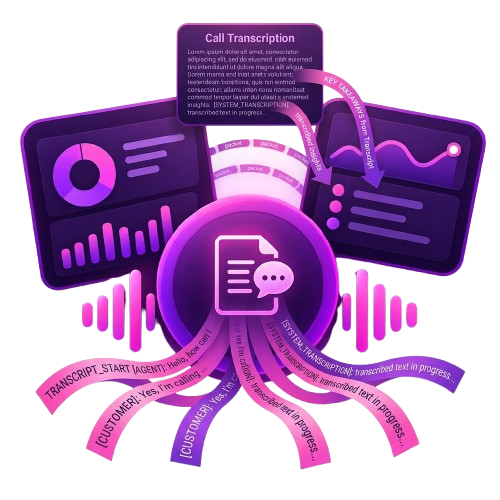
Call typing is the process of turning spoken talks over the phone into text. In place of reading the full audio, teams can read the talk, search for words, and quickly identify key details.
Call processing is a method of changing a spoken call to text using speech processing systems.
Example: say a customer calls a brand to ask on a good. Every discussion could be saved to a document including client enquiries or agent replies.
Modern systems can also identify different speakers, add timestamps, and organize conversations for easier review.
Call recordings make use of a mix of call recording and microphone software.
The platform records the interaction between both the client and the agent. Businesses must conform to all current guidelines and rules regarding call recording with client approval.
A voice analysis system handles the audio as it is recorded. The system analyzes spoken words and switches them into print..
The device creates a document of the discussion. The system can divide the agent's speech from the client's.
Teams can read the recording and avoid listening to the full tape. They can search for words, terms, customer issues, product names, and more useful data.
Call recordings make use of a mix of call recording and microphone software.
The platform records the interaction between both the client and the agent. Businesses must conform to all current guidelines and rules regarding call recording with client approval.
A voice analysis system handles the audio as it is recorded. The system analyzes spoken words and switches them into print..
The device creates a document of the discussion. The system can divide the agent's speech from the client's.
Teams can read the recording and avoid listening to the full tape. They can search for words, terms, customer issues, product names, and more useful data.
Per day, call centers handle a high level of client contacts. Manually analyzing the calls becomes challenging as the team grows.
Call recording helps leaders to convert talks into searchable text and review them more quickly.
Customer asked about pricing and available plans. Agent explained the available options.
Call center managers, for example, might need to look into how agents handle pricing queries. To avoid viewing hundreds of recordings, the manager can search text for talks about pricing.
This can help arrange quality tracking.
AI call analysis greatly increases call recording productivity.
While recording text captures the spoken content, AI-powered analysis uncovers trends in the conversations.
For example, an AI call analysis system may examine transcripts to identify:
Frequently discussed topics
Customer sentiment
Common objections
Agent performance patterns
Important keywords
Customer complaints
Follow-up opportunities
It allows businesses to get important data about client calls, in addition to just saving call recordings.
Yes, there are many ways that call recordings can help service teams.
Records can be monitored. Accuracy is a key factor in handling call centers.
In past times, managers might pick a few calls to listen to manually. Call recordings may accelerate the process by providing a written account of meetings.
Followed the call script
Asked the required questions
Provided accurate information
Used appropriate language
Explained the next steps
Handled customer concerns properly
But as automated recording sometimes makes errors, businesses should maintain clear quality guidelines and check records carefully.
Automated call transcription can provide several practical benefits:
Teams can read conversations instead of listening to long recordings.
Important conversations become searchable text.
Managers can use real conversations for coaching.
Teams can identify recurring topics and problems.
Transcripts can support CRM updates and follow-up activities when integrated with business systems.
Automated systems can process a large number of calls more efficiently than manual transcription.
A manual recording is when you watch a recording and type the talk. This can be helpful if you require a high level of information for some recordings but it can take a while.
Manual call transcription is software that transcribes voice to text in real-time.
For firms with a huge volume of calls, the technology of tasks might help to reduce human work.
But when truthfulness matters, human review can still be needed for key interactions.
Teams’ call recording could make discussions valuable papers. It can simplify call reviews, reduce time, educate agents, and provide teams with a broader view of consumer calls.
Automated recording is an important component of a modern call center and analytics system for call centers and sales teams that handle many types of calls.
Brands can get more value in every client call with call transcription, call recording, AI call analysis and CRM connection quality management.


Connect with your customers faster, smarter and more efficiently with AI-powered calling.